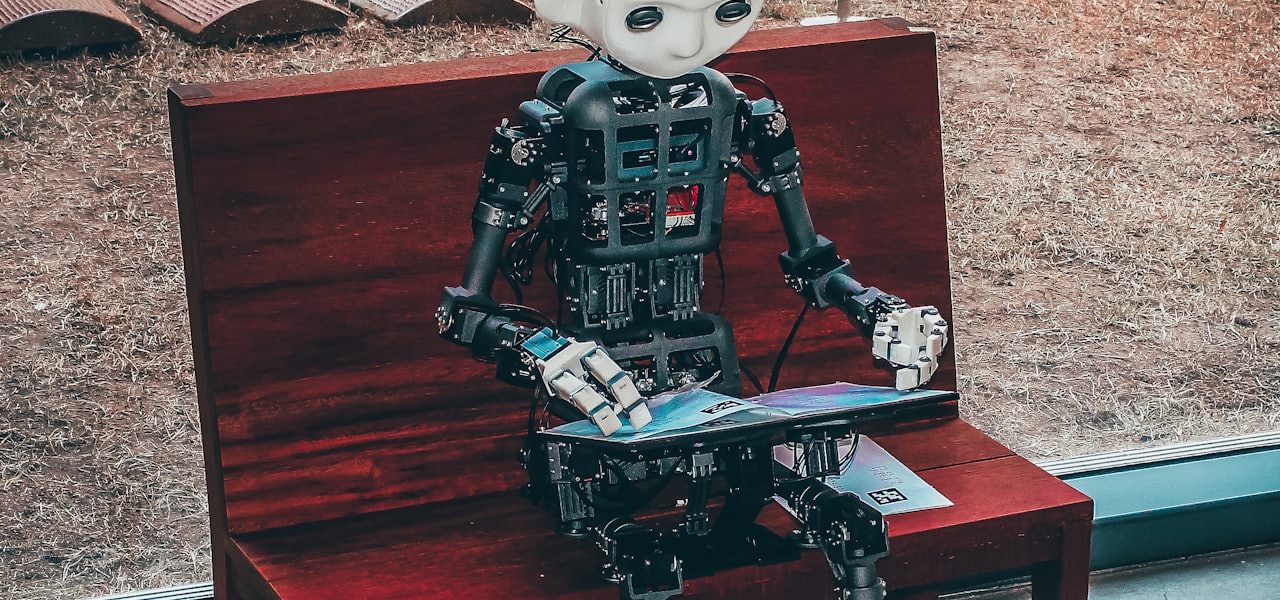
Shopping for the best AI writing assistant? An AI writing assistant is software that uses machine learning to help you get more done — it keeps getting smarter as the underlying models improve. Pricing, accuracy, and the size of the model behind the tool are the three factors that most affect daily usefulness. Whether you are a beginner or a pro, the right AI writing assistant slots into your workflow and pays for itself fast. Below we compare features, pricing, and real output so you can choose with confidence.
Outline of deep learning
The following outline is provided as an overview of, and topical guide to, deep learning: Deep learning is a subfield of machine learning and artificial intelligence based on artificial neural networks with multiple processing layers. It emphasizes representation learning and is widely used in areas such as computer vision, natural language processing, speech recognition, recommender systems, robotics, and generative artificial intelligence. == Ways to categorize deep learning == A field of study A branch of artificial intelligence A subfield of machine learning A subfield of computer science A form of representation learning A class of methods based on artificial neural networks An approach used in computational statistics == History == === Precursors === Cybernetics Perceptron Connectionism Neocognitron Backpropagation === Milestones === LeNet Long short-term memory Deep belief network AlexNet Sequence to sequence learning Generative adversarial network Residual neural network Transformer BERT Generative pre-trained transformer Diffusion model === Related histories === History of artificial intelligence History of machine learning Timeline of machine learning == Core concepts == == Learning settings == Supervised learning Unsupervised learning Self-supervised learning Semi-supervised learning Reinforcement learning Transfer learning Multitask learning Multimodal learning Online machine learning Continual learning == Common tasks == Image classification Object detection Image segmentation Automatic speech recognition Neural machine translation Question answering Automatic summarization Text-to-image model Protein structure prediction == Architectures == === Feedforward and convolutional architectures === Feedforward neural network Multilayer perceptron Convolutional neural network Radial basis function network Residual neural network U-Net === Recurrent and sequence architectures === Recurrent neural network Long short-term memory Gated recurrent unit Sequence to sequence learning Recursive neural network === Representation-learning architectures === Autoencoder Denoising autoencoder Sparse autoencoder Variational autoencoder Restricted Boltzmann machine Deep belief network === Attention and transformer architectures === Attention (machine learning) Transformer BERT Generative pre-trained transformer Vision transformer === Generative and probabilistic architectures === Autoregressive model Diffusion model Energy-based model Generative adversarial network Mixture of experts === Graph and memory architectures === Graph neural network Graph convolutional network Siamese network Neural Turing machine Memory network Echo state network Capsule neural network == Neural network components and techniques == Artificial neuron Activation function Rectified linear unit Sigmoid function Softmax function Embedding Convolution Pooling layer Attention Batch normalization Layer normalization Residual connections == Training and optimization == Backpropagation Gradient descent Stochastic gradient descent Adam optimization Learning rate Loss function Cross-entropy Mean squared error Regularization Dropout Early stopping Batch normalization Data augmentation Transfer learning Knowledge distillation Ensemble learning Curriculum learning == Datasets and benchmarks == CIFAR-10 ImageNet MNIST database Common Objects in Context (COCO) General Language Understanding Evaluation (GLUE) benchmark LibriSpeech SQuAD == Applications == === Computer vision === Computer vision Facial recognition system Image classification Image segmentation Medical imaging Object detection Optical character recognition === Natural language processing === Automatic summarization Chatbot Information retrieval Large language model Natural language processing Neural machine translation Question answering Sentiment analysis === Speech and audio === Automatic speech recognition Music information retrieval Speaker recognition Speech synthesis === Science and medicine === Bioinformatics Computational biology Drug discovery Medical diagnosis Protein structure prediction === Robotics and control === Autonomous car Computer game bot Control theory Robotics === Recommendation, search, and forecasting === Anomaly detection Forecasting Fraud detection Recommender system Search engine === Generative artificial intelligence === Deepfake Generative artificial intelligence Large language model Speech synthesis Text-to-image model === Computer graphics and video games === Deep Learning Anti-Aliasing (DLAA) Deep Learning Super Sampling (DLSS) == Hardware == AMD Instinct AMD XDNA Application-specific integrated circuit Deep learning processor, Neural processing unit (NPU), or Neural Engine Field-programmable gate array General-purpose computing on graphics processing units (GPGPU) Graphics processing unit NVIDIA Deep Learning Accelerator (NVDLA) Tensor processing unit Vision processing unit Wafer-scale integration === Supporting software platforms === CUDA Metal ROCm == Software == === Open-source frameworks and libraries === === Neural network software === EDLUT Emergent Encog JOONE Neuroph NeuroSolutions OpenNN Peltarion Synapse SNNS === Platforms, tools, and deployment === Amazon SageMaker Google Colab Hugging Face Kaggle Kubeflow MLflow ONNX OpenVINO TensorFlow Hub == Algorithms for deep learning and neural networks == Backpropagation Conjugate gradient method Generalized Hebbian algorithm Gradient descent Levenberg–Marquardt algorithm Perceptron Quasi-Newton method Wake-sleep algorithm == Methods and related topics == === Representation and metric learning === Contrastive learning Embedding Feature learning Manifold learning Metric learning === Generative modeling === Autoregressive model Diffusion model Generative adversarial network Generative model Variational inference === Efficient and scalable deep learning === Knowledge distillation Low-rank approximation Mixture of experts Quantization Sparsity === Reliability, safety, and interpretability === Adversarial machine learning AI alignment Algorithmic bias Catastrophic forgetting Differential privacy Explainable artificial intelligence Federated learning Hallucination (artificial intelligence) == Conferences and workshops == Annual Meeting of the Association for Computational Linguistics Conference on Computer Vision and Pattern Recognition Conference on Neural Information Processing Systems International Conference on Computer Vision International Conference on Learning Representations International Conference on Machine Learning == Organizations == === Research laboratories and institutions === Allen Institute for AI Alberta Machine Intelligence Institute European Laboratory for Learning and Intelligent Systems Google DeepMind Meta AI Mila Microsoft Research Vector Institute === Companies === Anthropic Cerebras Cohere DeepSeek Mistral AI OpenAI Stability AI xAI == Publications == === Books === Deep Learning – Ian Goodfellow and Yoshua Bengio Neural Networks and Deep Learning – Michael Nielsen Perceptrons – Marvin Minsky and Seymour Papert === Journals === IEEE Transactions on Neural Networks and Learning Systems Neural Networks Neural Computation == Influential persons ==
Tales from the Loop (role-playing game)
Tales from the Loop (Swedish: Ur Varselklotet), subtitled "Roleplaying in the '80s That Never Was", is an alternative history science fiction tabletop role-playing game published in 2017 by Free League Publishing, the international arm of Swedish game and book publisher Fria Ligan AB, and Modiphius Entertainment. The game, based on the art of Simon Stålenhag, envisions an alternative world where a group of bored and ignored preteens and teens solve mysteries caused by new technology near their hometown. == Description == === Setting === Tales from the Loop is set in an alternative history world taken from the artwork of Simon Stålenhag. According to this alternative timeline, back in the 1940s, research began on particle accelerators. In the 1960s, two massive underground particle accelerators were built in Sweden and Colorado with the promise of a harvest of technological marvels that would change everyone's lives. Tales from the Loop is set twenty years later, in the late 1980s, and the better life has not materialized. Although the particle accelerators have created robots and large skyships, the detritus of failed experiments and the ruins of abandoned high tech company buildings litter the landscape. Generally the life of the average family has not changed for the better. A campaign can either be set in the Mälaren Islands, west of the Swedish capital of Stockholm, or in a city in the Southwest United States that resembles Boulder City, Nevada. There is also a step-by-step guide for the gamemaster to use their own hometown. === Character generation === Player characters are preteens and young teenagers age 10–15 who live in a society where they are bored and largely left to themselves. Players can choose archetypes for their characters including Bookworm, Jock, Troublemaker, Popular Kid and Weirdo. Unlike most role-playing games, characters in Tales from the Loop cannot be killed, although in an ongoing campaign or due to an in-game effect, they are removed from the game if they reach the age of sixteen. === Game system === The game uses the Year Zero Engine first developed by Tomas Härenstam for the post-apocalyptic role-playing game Mutant: Year Zero. (Härenstam served as the editor and project manager for Tales from the Loop.) Problems are resolved by rolling a pool of six-sided dice, with any 6 rolled marking success. Attributes and skills (Sneak, Force, Move, Build, Tinker, Calculate, Contact, Charm, Lead, Investigate, Comprehend, and Empathize) may allow the player to add more dice to the dice pool, increasing the chances of success. However, if a character has earned a condition such as Scared or Injured, dice are removed from the dice pool. === Gameplay === The game principles are that life for the characters is dull and boring, but the area around the town is full of wonderful, mysterious things. An adventure is set up as a Mystery, and in order to successfully resolve the Mystery, characters must overcome a series of Troubles, which can range from having to be home by a certain time to dealing with a bully to disarming or otherwise overcoming a booby-trap on a door that must be opened. Each Mystery is played as a series of scenes, much like a TV drama. Although the gamemaster leads the players into the Mystery, each scene is set collaboratively with the players before action continues. As critic Jukka Kauppinen noted, "The players and the gamemaster take turns verbally staging a new scene — where we are, what it's like there — and only then what we do." === Campaign === The book presents a chronologically-linked set of four Mysteries called "The Four Seasons of Mad Science" that take place over a calendar year: "Summer Break and Killer Birds": The Kids hears pigeons having a conversation and investigate "Grown-Up Attraction": Adults start disappearing without any sign of struggle. "Creatures from the Cretaceous": The search for a missing dog leads to the discovery of creatures that don't belong in our time "I, Wagner": The Kids discover a body in a stream, and are drawn into a Mystery with robots and humans that may affect them closely. == Publication history == In 2017, Swedish artist Simon Stålenhag was raising money on Kickstarter to publish a book of his art titled Tales from the Loop. One of the stretch goals offered was the creation of a role-playing game. A second Kickstarter campaign to publish the role-playing game was initiated by Fria Ligan AB, who surpassed their crowdfunding goal and raised a total of 3,745,896 kr from 5,600 backers. The role-playing game Tales from the Loop was subsequently published as a 184-page hardcover book in 2017 by Free League Publishing, the international arm of Swedish game and book publisher Fria Ligan AB, and Modiphius Entertainment. Cover art and interior art were by Stålenhag, and cartography was by Christian Granath. A stand-alone expansion, Things from the Flood (Swedish: Flodskörden), based on Stålenhag's art book of the same name, was created by Nils Hintze, Rickard Antroia, and Tomas Härenstam. The 216-page hardcover book was published in 2019 with cover art by Stålenhag, interior art by Stålenhag and Reine Rosenberg, and cartography by Christian Granath. In 2020, the setting of the role-playing game was transferred to the TV series Tales from the Loop developed by Nathanial Halpern and Simon Stålenhag. The series tells eight stories of children's encounters with strange technology. == Reception == Shut Up & Sit Down praised Tales from the Loop for its comfortable, contemporary setting, simple rules that make the game easy to run, and the alternation between sci-fi and the kids' lives, but criticized the Type system for characters, noting "a suggested 'Pride' for the Weirdo involved being homosexual –– the only mention of queerness in the entire game. Those of us who identify as GLBTQ bristled at that: why was only the Weirdo queer, with queerness as a (possibly secret) Pride? Why not more fully address being a GLBTQ kid in the 1980s?" The review concluded, "For new RPG players, Tales is a decent game that you'll enjoy and that will make your heart burst. But you need an experienced GM who’s able to either alter the book’s mysteries or create their own, and who can put in work when poor dice rolls hold the players back." Rob Weiland of Geek & Sundry named Tales from the Loop 2017's best RPG release and praised Stålenhag's art, the collaborative nature between the GM and players, and the simplicity of running the game. Weiland concluded, "It has a simple system that is easy to explain but holds up under several plays. It has a setting that’s immediately evocative but also leaves plenty of room for GMs to build out their own world. It offers players a chance to experience the rush of memory, the pain of childhood and the wonder of movies." In a review of Tales from the Loop in Black Gate, Andrew Zimmerman Jones said, "Though not based directly on an established franchise, it draws richly from elements of popular culture that will make it resonate with many players. The focus on narrative play also means it’s a good game for people who aren’t necessarily big into learning a ton of new rules." Jukka Kauppinen, writing for the Finnish games magazine Skrolli, called the game, "downright delicious in its diversity. The science fiction world created by the Swedish artist Simon Stälenhag is, after all, both delightful vintage and tickling novelty." Kauppinen concluded, "This mutual storytelling and interaction makes this game more of a campfire circle than a traditional role-playing game. At the same time, its setting in the real world, tinged with science fiction and even horror, creates a delicious and unique adventure environment." In his 2023 book Monsters, Aliens, and Holes in the Ground, RPG historian Stu Horvath noted that the game system "pushes the players to constantly reevaluate their characters' relationships with the everyday world, for better or worse. It won't be long before navigating entanglements with parents, teachers, siblings and bullies proves just as risky to the characters, and central to the players' experience, as trying to find out what happened with the time portal or dealing with a rampaging robot." Horvath concluded, "The appeal of Tales from the Loop is Stålenhag's deep shadows and purple dusks. They hide the dangers and mysteries that often act [as] an escape hatch, a way to avoid prosaic problems." == Awards == At the 2017 Golden Geek Awards, Tales of the Loop won "RPG of the Year", and was a finalist for " Best RPG Artwork/Presentation" At the 2017 ENnie Awards, Tales from the Loops won five Gold Medals: Product of the Year Best Writing Best Setting Best Game Best Art, Interior
Fuzzy concept
A fuzzy concept is an idea of which the boundaries of application can vary considerably according to context or conditions, instead of being fixed once and for all. That means the idea is somewhat vague or imprecise. Yet it is not unclear or meaningless. It has a definite meaning, which can often be made more exact with further elaboration and specification — including a closer definition of the context in which the concept is used. The inverse of a "fuzzy concept" is a "crisp concept" (i.e. a precise concept). Fuzzy concepts are often used to navigate imprecision in the real world, when precise information is not available and an approximate indication is sufficient to be helpful. Although the linguist George Philip Lakoff already defined the semantics of a fuzzy concept in 1973 (inspired by an unpublished 1971 paper by Eleanor Rosch,) the term "fuzzy concept" rarely received a standalone entry in dictionaries, handbooks and encyclopedias. Sometimes it was defined in encyclopedia articles on fuzzy logic, or it was simply equated with a mathematical “fuzzy set”. A fuzzy concept can be "fuzzy" for many different reasons in different contexts. This makes it harder to provide a precise definition that covers all cases. Paradoxically, the definition of fuzzy concepts may itself be somewhat "fuzzy". Lotfi A. Zadeh, known as "the father of fuzzy logic", claimed that "vagueness connotes insufficient specificity, whereas fuzziness connotes unsharpness of class boundaries". Not all scholars agree. With increasing academic literature on the subject, the term "fuzzy concept" is now more widely recognized as a philosophical, linguistic or scientific category, and the study of the characteristics of fuzzy concepts and fuzzy language is known as fuzzy semantics. “Fuzzy logic” has become a generic term for many different kinds of many-valued logics, and is applied in many different areas of research, computer programming and industrial design. For engineers, "Fuzziness is imprecision or vagueness of definition." For computer scientists, a fuzzy concept is an idea which is "to an extent applicable" in a situation. It means that the concept can have gradations of significance or unsharp (variable) boundaries of application — a "fuzzy statement" is a statement which is true "to some extent", and that extent can often be represented by a scaled value (a score). For mathematicians, a "fuzzy concept" is usually a fuzzy set or a combination of such sets (see fuzzy mathematics and fuzzy set theory). In cognitive linguistics, the things that belong to a "fuzzy category" exhibit gradations of family resemblance, and the borders of the category are not clearly defined. Through most of the 20th century, the idea of reasoning with fuzzy concepts faced considerable resistance from Western academic elites. They did not want to endorse the use of imprecise concepts in research or argumentation, and they often regarded fuzzy logic with suspicion, derision or even hostility. That may partly explain why the idea of a "fuzzy concept" did not get a separate entry in encyclopedias, handbooks and dictionaries. Yet although people might not be aware of it, the use of fuzzy concepts has risen gigantically in all walks of life from the 1970s onward. That is mainly due to advances in electronic engineering, fuzzy mathematics and digital computer programming. The new technology allows very complex inferences about "variations on a theme" to be anticipated and fixed in a program. The Perseverance Mars rover, a driverless NASA vehicle used to explore the Jezero crater on the planet Mars, features fuzzy logic programming that steers it through rough terrain. Similarly, to the North, the Chinese Mars rover Zhurong used fuzzy logic algorithms to calculate its travel route in Utopia Planitia from sensor data. New neuro-fuzzy computational methods make it possible for machines to identify, measure, adjust and respond to fine gradations of significance with great precision. It means that practically useful concepts can be coded, sharply defined, and applied to all kinds of tasks, even if ordinarily these concepts are never exactly defined. Nowadays engineers, statisticians and programmers often represent fuzzy concepts mathematically, using fuzzy logic, fuzzy values, fuzzy variables and fuzzy sets (see also fuzzy set theory). Fuzzy logic is not "woolly thinking", but a "precise logic of imprecision" which reasons with graded concepts and gradations of truth. Fuzzy concepts and fuzzy logic often play a significant role in artificial intelligence programming, for example because they can model human cognitive processes more easily than other methods. == Origins == Vagueness and fuzziness have probably always been a part of human experience. In the West, ancient texts show that philosophers and scientists were already thinking critically about this in classical antiquity. Most often, they regarded vagueness as a problem: as an obstacle to clear thinking, as a source of confusion, or as an evasive tactic. It got in the way of providing clear orientation, guidance, direction and leadership. Therefore, vagueness became associated with a hermeneutic of suspicion — it was considered as something to avoid, as something undesirable. By contrast, in the ancient Chinese tradition of Daoist thought of Laozi and Zhuang Zhou, "vagueness is not regarded with suspicion, but is simply an acknowledged characteristic of the world around us" — a subject for meditation and a source of insight. === Sorites paradox === The ancient Sorites paradox raised the logical problem, of how we could exactly define the threshold at which a change in quantitative gradation turns into a qualitative or categorical difference. With some physical processes, this threshold seems relatively easy to identify. For example, water turns into steam at 100 °C or 212 °F. Of course, the boiling point depends partly on atmospheric pressure, which decreases at higher altitudes; it is also affected by the level of humidity — in that sense, the boiling point is "somewhat fuzzy", because it can vary under different conditions. Nevertheless, for every altitude, level of air pressure and degree of humidity, we can predict accurately what the boiling point will be, if we know the relevant conditions. With many other processes and gradations, however, the point of change is much more difficult to locate, and remains somewhat vague. Thus, the boundaries between qualitatively different things may be unsharp: we know that there are boundaries, but we cannot define them exactly. For example, to identify "the oldest city in the world", we have to define what counts as a city, and at what point a growing human settlement becomes a city. === The continuum fallacy and Loki's wager === According to the modern idea of the continuum fallacy, the fact that a statement is to an extent vague, does not automatically mean that it has no validity. The question then arises, of how (by what method or approach) we could ascertain and define the validity that the fuzzy statement does have. The Nordic myth of Loki's wager suggested that concepts that lack precise meanings or lack precise boundaries of application cannot be operated with, because they evade any clear definition. However, the 20th-century idea of "fuzzy concepts" proposes that "somewhat vague terms" can be operated with, because we can explicate and define the variability of their application — by assigning numbers to gradations of applicability. This idea sounds simple enough, but it had large implications. === Precursors and pioneers === In Western civilization, the intellectual recognition of fuzzy concepts has been traced back to a diversity of famous and less well-known thinkers, including (among many others) Eubulides, Epicurus, Plato, Cicero, William Ockham and John Buridan, Georg Wilhelm Friedrich Hegel, Karl Marx and Friedrich Engels, Friedrich Nietzsche, William James, Hugh MacColl, Charles S. Peirce, Hans Reichenbach, Carl Gustav Hempel, Max Black, Arto Salomaa, Ludwig Wittgenstein, Jan Łukasiewicz, Emil Leon Post, Alfred Tarski, Georg Cantor, Nicolai A. Vasiliev, Kurt Gödel, Stanisław Jaśkowski, Willard Van Orman Quine, George J. Klir, Petr Hájek, Joseph Goguen, Ronald R. Yager, Enrique Héctor Ruspini, Jan Pavelka, Didier Dubois, Bernadette Bouchon-Meunier, and Donald Knuth. Across at least two and a half millennia, all of them had something to say about graded concepts with unsharp boundaries. This suggests at least that the awareness of the existence of concepts with "fuzzy" characteristics, in one form or another, has a very long history in human thought. Quite a few 20th century logicians, mathematicians and philosophers also tried to analyze the characteristics of fuzzy concepts as a recognized species, sometimes with the aid of some kind of many-valued logic or substructural logic. An early attempt in the post-WW2 era to create a mathematical theory of sets with gradations of
Supreme Commander (video game)
Supreme Commander (sometimes SupCom) is a 2007 real-time strategy video game designed by Chris Taylor and developed by his company, Gas Powered Games. The game is considered to be a spiritual successor, not a direct sequel, to Taylor's 1997 game Total Annihilation. First announced in the August 2005 edition of PC Gamer magazine, the game was released in Europe on February 16, 2007, and in North America on February 20. The standalone expansion Supreme Commander: Forged Alliance was released on November 6 of the same year. The sequel, Supreme Commander 2, was released in 2010. Nowadays, the original Supreme Commander is played through the community client called Forged Alliance Forever; the game has been further developed and balanced, and offers a wide variety of community mods. The gameplay of Supreme Commander focuses on using a giant bipedal mech called an Armored Command Unit (ACU), the so-called "Supreme Commander", to build a base, upgrading units to reach higher technology tiers, and conquering opponents. The player can command one of three factions: the Aeon Illuminate, the Cybran Nation, or the United Earth Federation (UEF). The expansion game added the Seraphim faction. Supreme Commander was highly anticipated in pre-release previews, and was well received by critics, with a Metacritic average of 86 out of 100. == Gameplay == Supreme Commander, like its spiritual predecessors, Total Annihilation and Spring, begins with the player solely possessing a single, irreplaceable construction unit called the "Armored Command Unit," or ACU, the titular Supreme Commander. Normally the loss of this unit results in the loss of the game (Skirmish missions can be set for a variety of victory conditions). These mech suits are designed to be transported through quantum gateways across the galaxy and contain all the materials and blueprints necessary to create an army from a planet's native resources in hours. All standard units except Commanders and summoned Support Commanders (sACU) are self-sufficient robots. All units and structures belong to one of four technology tiers, or "Tech" levels, each tier being stronger and/or more efficient than the previous. Certain lower-tier structures can be upgraded into higher ones without having to rebuild them. The first tier is available at the start of the game and consists of small, relatively weak units and structures. The second tier expands the player's abilities greatly, especially in terms of stationary weapons and shielding, and introduces upgraded versions of tier one units. The third tier level has very powerful assault units designed to overcome the fortifications of the most entrenched player. The fourth tier is a limited range of "experimental" technology. These are usually massive units which take a lot of time and energy to produce, but provide a significant tactical advantage. Supreme Commander features a varied skirmish AI. The typical Easy' and Normal modes are present, but the Hard difficulty level has four possible variants. Horde AI will swarm the player with hordes of lower level units, Tech AI will upgrade its units as fast as possible and assault the player with advanced units, the Balanced AI attempts to find a balance between the two, and the Supreme AI decides which of the three hard strategies is best for the map. The single player campaign consists of eighteen missions, six for each faction. The player is an inexperienced Commander who plays a key role in their faction's campaign to bring the "Infinite War" to an end. Despite the low number of campaign missions, each mission can potentially last hours. At the start of a mission, objectives are assigned for the player to complete. Once the player accomplishes them, the map is expanded, sometimes doubling or tripling in size, and new objectives are assigned. As the mission is commonly divided into three segments, the player will often have to overcome several enemy positions to achieve victory. === Resource management === Because humans have developed replication technology, making advanced use of rapid prototyping and nanotechnology, only two types of resources are required to wage war: Energy and Mass. Energy is obtained by constructing power generators on any solid surface (except fuel generators, which can only be built on fuel deposits), while Mass is obtained either by placing mass extractors on limited mass deposit spots (the most efficient method, although it requires map control) or by building mass fabricators to convert energy into mass. Constructor units can gather energy by "reclaiming" it from organic debris such as trees and mass from rocks and wrecked units. Each player has a certain amount of resource storage, which can be expanded by the construction of storage structures. This gives the player reserves in times of shortage or allows them to stockpile resources. If the resource generation exceeds the player's capacity, the material is wasted. On the contrary, if the storages are depleted and the demand of one of the resources exceeds the production, then all the productions speed is reduced. In addition, if an energy deficit occurs, shields will stop working. An adjacency system allows certain structures to benefit from being built directly adjacent to others. Energy-consuming structures will use less energy when built adjacent to power generators and power generators will produce more energy when built adjacent to power storage structures. The same applies to their mass-producing equivalents. Likewise, factories will consume less energy and mass when built adjacent to power generators and mass fabricators/extractors, respectively. However, by placing structures in close proximity, they become more vulnerable to collateral damage if an adjacent structure is destroyed. Furthermore, most resource generation structures can cause chain reactions when destroyed (especially Tier III structures, which produce large amounts of resources but often have large detonations that can wipe out a nearby army). === Warfare === Supreme Commander uses a "strategic zoom" system that allows the player to seamlessly zoom from a detailed close up view of an individual unit all the way out to a view of the entire map, at which point it resembles a fullscreen version of the minimap denoting individual units with icons. The camera also has a free movement mode and can be slaved to track a selected unit and there is a split screen mode which also supports multiple monitors. This system allows Supreme Commander to use vast maps up to 80 km x 80 km, with players potentially controlling a thousand units each. Units in Supreme Commander are built to scale as they would be in the real world. For example, battleships dwarf submarines. Late into the game, the larger "experimental" units, such as the Cybran Monkeylord, an enormous spider-shaped assault unit, can actually crush smaller enemy units by stepping on them. Because of the wide range of planets colonized by humanity in the setting, the theatres of war range from desert to arctic, and all battlespaces are employed. Technologies emerging in modern warfare are frequently employed in Supreme Commander. For example, stealth technology and both tactical and strategic missile and missile defense systems can be used. Supreme Commander introduced several innovations designed to reduce the amount of micromanagement inherent in many RTS games. Engineers units have the command "assist", that will help follow other engineers and help them finish their orders or improve production rate of factories. In addition, engineers with the order "patrol" will repair units, buildings and recycle wrecks in their along their patrol route. Holding the shift key causes any orders given to a unit (or group of units) to be queued. In this manner a unit may be ordered to attack several targets in succession, or to make best speed to a given point on the map and then attack towards a specified location engaging any hostiles it encounters along the way. After orders have been issued, holding the shift key causes all issued orders to be displayed on the map where they can be subsequently modified to accommodate a change of plan. Further, when a unit is ordered to attack a target, the player can issue an order to perform a coordinated attack to another unit. This order coordinates the arrival time of the units at the target automatically by adjusting the speed of the units involved. As in other RTS games, air transports can be used to convey units to specified destinations, in Supreme Commander though by shift queuing orders a transport containing several units can be ordered to drop specific units at subsequent waypoints. An air transport can also be ordered to create a ferry route, an airbridge wherein any land units ordered to the start of the ferry route will be conveyed by the air transport to the specified destination. The output from a production factory can be routed to a ferry route causing all units co
EffectsLab Pro
EffectsLab Pro is a discontinued visual effects software product developed by FXhome. It has since been superseded by the FXhome HitFilm range. The company also produced a limited functionality version, EffectsLab Lite, containing just the Particle engine. A more extensive product, VisionLab Studio, combined the functionality of EffectsLab Pro and the company's CompositeLab Pro product with enhancements to both. == Effects Engines == The effects are generated by the program's effect engines: The Neon Light engine allows light beams to be drawn onto the video, allowing the generation of lightsaber-like weapons, neon lighting, fantasy glow effects and laser blasts. The Particle engine is used for particle effects, such as smoke, fire, explosions, and weather effects. The Muzzle Flash engine is designed for creating and animating muzzle flashes such as machine gun firing, tank blasts, etc. It's possible to rotate the created muzzle flash in 3D, making it the only engine with 3D use. The Optics engine is designed for creating artificial lens flares and light sources. It is useful for enhancing other light-based effects, and mimicking the distinctive flashes of light that accompany Star Wars' lightsaber battles. The Laser engine (introduced in EffectsLab Pro in late 2007) is designed as a simplified method of creating laser weapon effects, including the ability to add simulated perspective to the effect. == Presets == EffectsLab Pro allows the user to save the effects using presets. Since all effects are generated from settings in the different engines, it is fairly easy to generate an XML style description of the effect. It is also possible to share presets on FXhome's website.
Removal of Sam Altman from OpenAI
On November 17, 2023, OpenAI's board of directors ousted co-founder and chief executive Sam Altman. In an official post on the company's website, it was stated that "the board no longer has confidence in his ability to continue leading OpenAI". The removal was predicated by employee concerns about his handling of artificial intelligence safety, and allegations of abusive behavior. Altman was reinstated on November 22 after pressure from employees and investors. The removal and subsequent reinstatement caused widespread reactions, including impacts felt in the financial markets and technology sector. Microsoft, a partner of OpenAI, received little notice of the removal and experienced a drop in the share price of its stock. The removal also promoted interest in investigations from regulatory agencies. == Background == === OpenAI === OpenAI is an artificial intelligence firm founded in December 2015 as a non-profit entity. The for-profit division of the organization released ChatGPT in November 2022, contributing to a resurgence in generative artificial intelligence funding. The board of directors of the controlling non-profit formerly comprised chief scientist Ilya Sutskever, as well as Adam D'Angelo, chief executive of Quora, entrepreneur Tasha McCauley, and Helen Toner, strategy director for the Center for Security and Emerging Technology. As of October 2023, the company is valued at US$80 billion and was set to bring in US$1 billion in revenue. Altman has described OpenAI's relationship with Microsoft as the "best bromance in tech". OpenAI is uniquely structured, an intentional decision to avoid investor control. A board of directors controls the non-profit OpenAI, Inc. The non-profit owns and controls a for-profit company itself controlling a capped-profit company, OpenAI Global, LLC and a holding company owned by employees and other investors. The holding company is the majority owner of OpenAI Global, LLC.; Microsoft owns a minority stake in the capped-profit company. OpenAI's bylaws, enacted in January 2016, allow a majority of its board of directors to remove any director without prior warning or a formal meeting with written consent. === Sam Altman === Sam Altman is a co-founder of OpenAI and its former chief executive; Altman took over the company following co-chair Elon Musk's resignation in 2018. Under Altman, OpenAI has shifted to becoming a for-profit entity. Altman is credited with convincing Microsoft chief executive Satya Nadella with investing US$10 billion in cash and computing credits into OpenAI and leading several tender offer transactions that tripled the company's valuation. Altman testified before the United States Congress speaking critically of artificial intelligence and appeared at the 2023 AI Safety Summit. In the days leading up to his removal, Altman made several public appearances, announcing the GPT-4 Turbo platform at OpenAI's DevDay conference, attending APEC United States 2023, and speaking at an event related to Burning Man. == Events leading up to the removal == The resignation of LinkedIn co-founder Reid Hoffman, venture capitalist Shivon Zilis, and former Republican representative Will Hurd from the board allowed the remaining members to remove Altman. According to Kara Swisher and The Wall Street Journal, Sutskever was instrumental in Altman's removal. Disagreements over the safety of artificial intelligence divided employees prior to Altman's removal. The release of ChatGPT created divisions with OpenAI as a for-profit company without considerations for the safety of artificial intelligence and a non-profit cautious of artificial intelligence's capabilities; in a staff email sent in 2019 and obtained by The Atlantic, Altman referred to these divisions as "tribes". Prior to his removal, Altman was seeking billions from Middle Eastern sovereign wealth funds to develop an artificial intelligence chip to compete with Nvidia and courted SoftBank chairman Masayoshi Son to develop artificial intelligence hardware with former Apple designer Jony Ive. Sutskever and his allies opposed these efforts, viewing them as unjustly using the OpenAI name. Altman reduced Sutskever's role in October 2023, furthering divisions; Sutskever successfully appealed to several members of the board. Swisher and The Verge reporter Alex Heath stated that opposition to Altman's profit-driven strategy culminated in the DevDay conference in which Altman announced custom ChatGPT instances. According to Axios, the removal was driven by growing discontent and distrust with Altman. On November 22, 2023, reports emerged suggesting that Sam Altman's dismissal from OpenAI might be linked to his alleged mishandling of a significant breakthrough in the organization's secretive project codenamed Q. According to sources within OpenAI, Q is aimed at developing AI capabilities in logical and mathematical reasoning, and reportedly involves performing math on the level of grade-school students. Concerns about Altman's response to this development, specifically regarding the potential safety implications of the discovery, were reportedly raised to the company's board shortly before his firing. A report from The Washington Post in December stated that OpenAI's board of directors were concerned over Altman's allegedly abusive behavior; the complaints were purportedly a major factor in his removal. The Post previously reported that Altman's alleged pattern of deception and subversiveness that ostensibly resulted in his removal from Y Combinator ultimately resulted in the board's decision to remove him. In April 2026, an investigative report from The New Yorker found that Sutskever and others, in response to the board's request, had compiled an approximately 70-page-long annotated dossier consisting of internal communications, documents, and photos. The dossier claimed that Altman "exhibits a consistent pattern of [...] Lying", and that Altman misrepresented information to the company's senior management and board, particularly regarding safety issues. == Removal == On November 17, 2023, at approximately noon PST, OpenAI's board of directors ousted Altman effective immediately following a "deliberative review process". The board concluded that Altman was not "consistently candid in his communications". Altman was informed of his removal five to ten minutes before it occurred on a Google Meet while watching the Las Vegas Grand Prix. Within thirty minutes, Sutskever invited OpenAI chairman and president Greg Brockman to a Google Meet to inform him of Altman's removal. According to an internal memo obtained by Axios, the removal was not due to "malfeasance", and OpenAI chief executive Emmett Shear denied accusations that the removal was due to disagreements. The board publicly announced Altman's removal thirty minutes later. Chief Technology Officer Mira Murati was immediately appointed to interim chief executive officer. Hours after Altman's removal, Brockman resigned as chairman, joined by director of research Jakub Pachocki and researchers Aleksander Mądry and Szymon Sidor. During an all-hands meeting, Sutskever defended the ouster and denied accusations of a hostile takeover. An OpenAI representative requested former board member Will Hurd's presence. == Reinstatement == According to The New Yorker, Altman retreated to his San Francisco home and enlisted the help of communications consultant Chris Lehane and Airbnb chief executive Brian Chesky, as well as former staff and a legal team, to plan his reinstatement. Lehane encouraged Altman to engage on social media, while Chesky sent a journalist negative information about the board. Altman told interim CEO Murati that his team was conducting opposition research on her and the individuals responsible for his removal; Altman later stated he did not remember saying this. Altman insisted multiple times that all board members who supported his removal should resign. Tiger Global Management and Sequoia Capital had attempted to reinstate Altman, according to The Information; Bloomberg News reported that Microsoft and Thrive Capital were seeking Altman's reinstatement. On November 18, The Verge reported that OpenAI's board of directors discussed reinstating Altman. The board agreed in principle to resign and to allow Altman to return, but missed the deadline. According to The Verge, Altman was ambivalent about returning and would seek significant changes to the company, including replacing the board. A list of directors had been prepared by investors in the event that the board steps down, and purportedly included former Salesforce executive Bret Taylor. According to chief strategy officer Jason Kwon, OpenAI was optimistic it could return Altman, Brockman, and other employees. On November 19, Altman and Brockman appeared at OpenAI's headquarters to negotiate, mediated by Nadella. According to Bloomberg News, Murati, Kwon, and chief operating officer Brad Lightcap were pushing for a new board of direc